
Co-driver guide · pacenotes rally
Rally pacenotes explained: how to read and write pacenotes (numbers, corner grading, calls)
If you're new to the co-driver's seat, pacenotes (also called pace notes) are the shorthand you write on the recce and then read to the driver on the stage. They describe what's coming: how tight a corner is, which way it goes, and what's waiting after it.
This guide is about the language itself — numbers, corner grading and calls — not the kit you hold on your lap. For books, lights and pen clips, see our separate rally pace notes kit guide. Product details below come from Race and Rally in Lisburn. It's a planning aid, not a rulebook, so always check your event's regulations too.
1. What pacenotes are for
On a stage rally you usually get a reconnaissance, or recce, to look at the route beforehand. That's when the co-driver writes the notes. Later, in the stage, you read those notes so the driver knows what's coming before they can see it: a tightening right, a crest, a long left, a caution, a jump, or a stretch of straight.
The notes only work if two things stay consistent: the system you both agreed, and the way you deliver it. A beautifully written book is no use if the calls don't match what the driver expects, or if they can't hear you.
2. Numbers and corner grading
Most crews grade corners with a number plus a direction (left or right). The important point is that the scale belongs to the crew, not to a single official rulebook. Some teams use 1 to 6, others 1 to 9 or 1 to 10. And some crews invert the scale, so a 1 is their tightest corner rather than their fastest.
The table below is one widely used example, where a higher number means a tighter, slower corner. Treat it as a starting point to discuss with your driver, not as a standard you have to follow.
| Grade | What it usually means | How you might think of it |
|---|---|---|
| 1 | A very slight bend or kink | Almost straight; often taken flat in a suitable car |
| 2 | A gentle corner | A small lift or a small steering input |
| 3 | A medium corner | A clear turn, but still reasonably open |
| 4 | A noticeably tighter corner | You'd expect a real change of speed |
| 5 | A tight corner | Slow, with limited room to get it wrong |
| 6 | A very tight corner or hairpin | The tightest grade on this scale; often a hairpin |
3. Common calls you'll write and read
The number describes the corner. The calls around it describe how that corner behaves, and what's immediately before or after it. Crews differ here too, so keep a short, shared vocabulary rather than inventing a new word for every bump.
| Call | Typical meaning |
|---|---|
| Left / Right (or L / R) | The direction of the corner, always paired with the grade. |
| Tightens | The corner gets tighter as you go through it. |
| Opens | The corner opens out; it becomes faster or straighter. |
| Long / Short | How long you stay in the corner, not how tight it is. |
| Crest | The road rises and your view ahead is limited. |
| Jump | The car may leave the ground, or the compression needs respect. |
| Don't cut | Stay off the inside; there may be a rock, post, ditch or hole. |
| Caution | A hazard or a place that needs extra respect. Don't overuse it, or it stops meaning anything. |
| Distances (for example 50, 100) | The gap to the next note, so the driver can judge how soon it arrives. |
A simple line might read something like: “100, 4 left tightens, don't cut, 50, 2 right over crest.” The exact shorthand is up to you, as long as you both hear the same thing when you say it at stage speed.
4. How to write notes on the recce
Write the notes the way you'll say them later. If you won't say “slightly decreasing radius right”, don't write it. Use the grade and the calls you agreed, in the same order every time: distance, grade and direction, then modifiers, then the next distance.
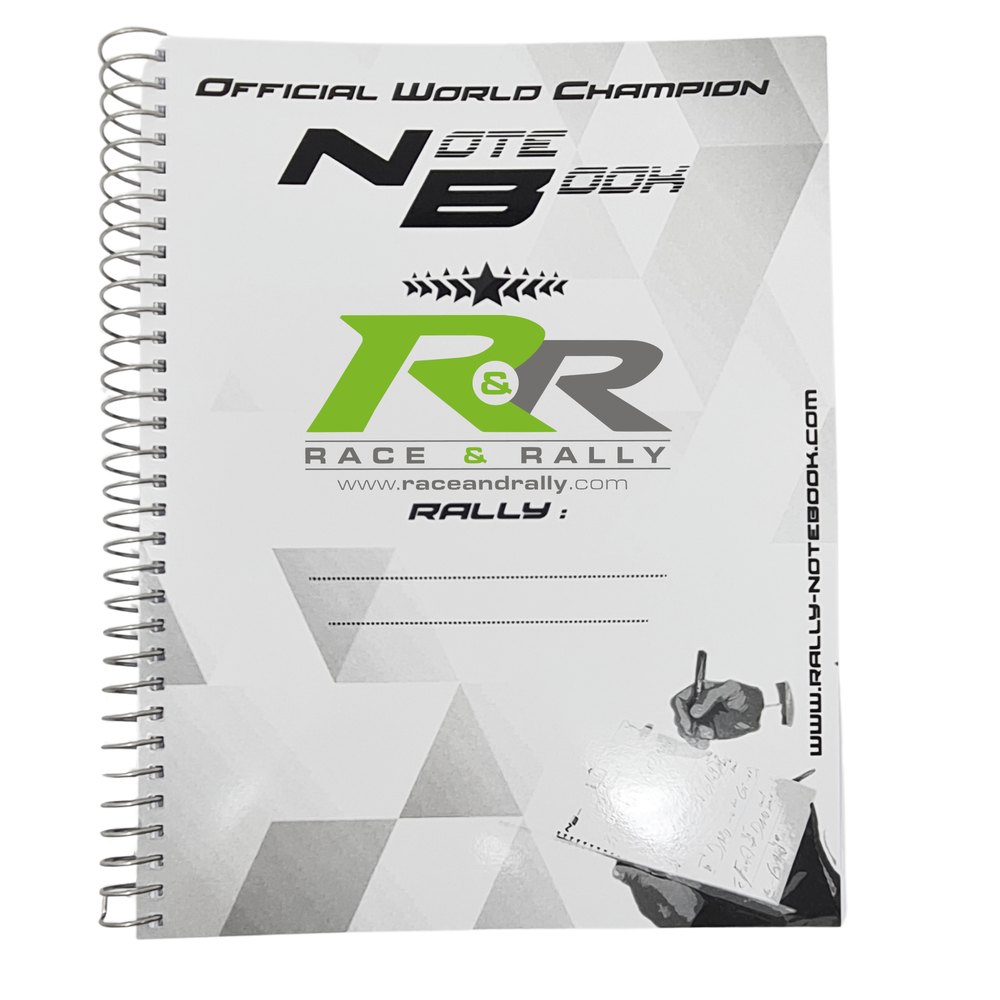
Keep the page tidy enough to read with gloves on and the car moving. Race and Rally's NoteBook pacenote books are described as professional rally pacenote books for co-drivers, used in the ERC and WRC. The Standard is 265mm × 205mm; the A4 is the same width and 30mm taller at 295mm. Both have 110 pages on a 5-line light grey grid, 5 dividers, 5 time sheets, a cardboard cover and spine, and wire binding that turns 360 degrees and can be assembled or taken apart.
The dividers help you split an event into sections so you can find the next stage quickly. Leave a little space to amend a line after a second recce pass if the event allows it. If you're also assembling the rest of the bag — lights, pens, a co-driver bag — that's covered in the pace notes kit guide and in the wider co-driver collection.
5. How to read notes in the stage
Reading is timing as much as language. The driver needs the next call early enough to act, but not so early that it muddles the corner they're already in. Practise the rhythm on the recce and in a quiet road section: grade and direction first, then the extra information, then the distance to what's next.
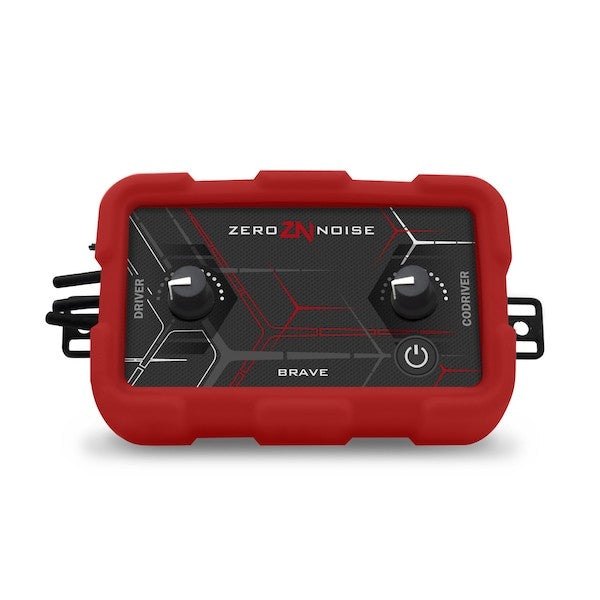
They also have to hear you. That's the job of the intercom, which sits in Race and Rally's intercoms collection. Two examples from the range, using the details published on the product pages:
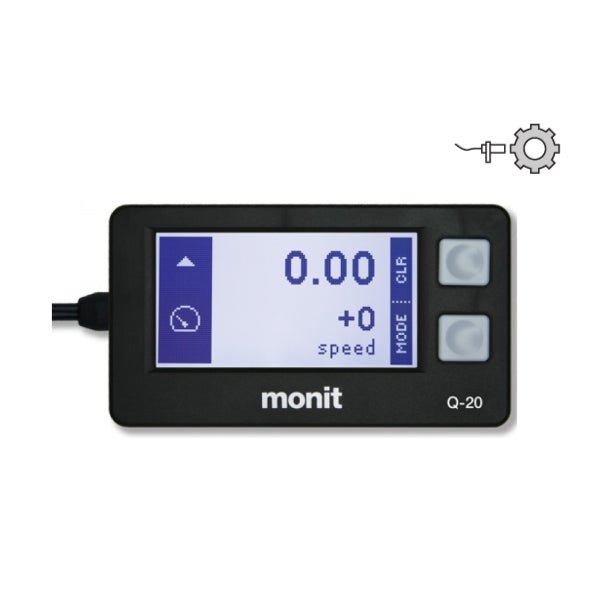
A trip meter helps you call distances consistently. Race and Rally lists trip computers and accessories in its trip computers and meters collection. If you're choosing a first unit, the Q-20's published description specifically mentions pace note events; check the product page for the matching sensor (inductive wheel probe, speed sensor interface or ABS interface).
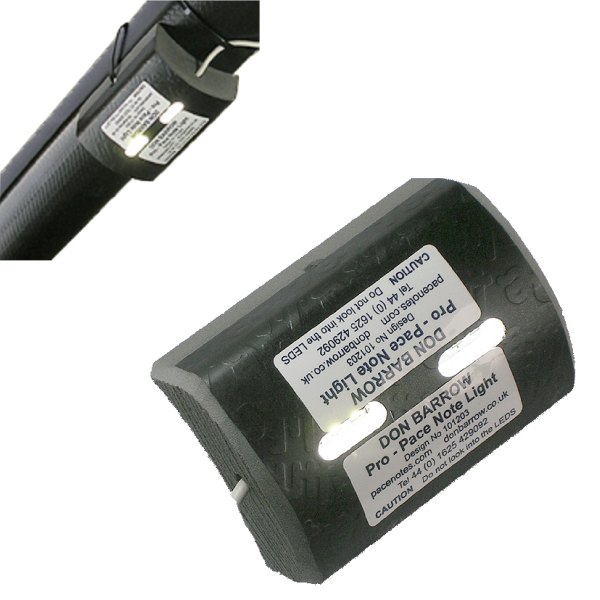
And if you're running at night or in dark forest stages, you can't read what you can't see. A map or pacenote light aimed at the book is part of that — the Don Barrow Pro above is one option — with the full comparison in the kit guide.
A short checklist before your first recce
- Agree the number scale and whether 1 is slight or tight.
- Agree the calls you'll actually use, and the order you'll say them in.
- Write in that same order, neatly enough to read at stage speed.
- Test the intercom volumes with helmets on, engine running.
- Fit and aim a map or pacenote light if you'll be reading in the dark.
- Set up your trip meter and confirm the units (miles or kilometres) match the notes.
- Read the event regulations, and ask the organiser if anything's unclear.
Product details summarised from raceandrally.com on 17 November 2026. Specifications and availability can change, so check the product page or call the shop before you order. Corner-grade examples in this guide are a common starting point for discussion with your driver, not an official Motorsport UK or FIA scale.